
This Robot Watched a 12-Second Demo and Tried the Job. Did AGI Just Get Closer?
No, this does not mean your toaster is plotting yet.
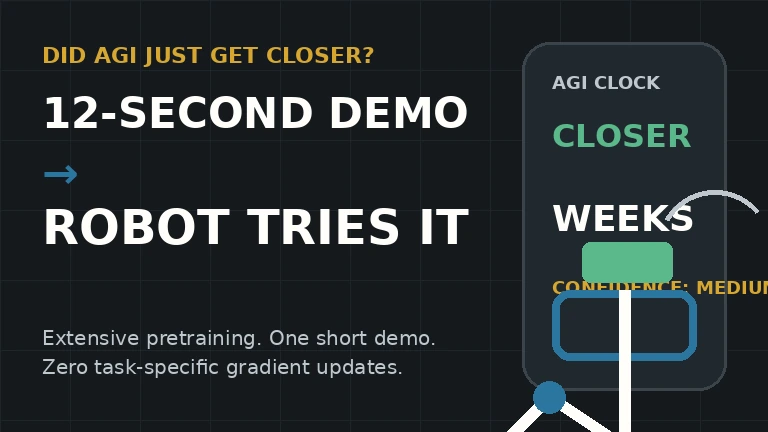
A robot watched a few seconds of someone doing a physical task, then tried to do the job itself. Not after a new round of training. Not after thousands of examples. One short demonstration, then straight into the attempt.
That is either a small but real step toward general learning—or a very expensive intern with excellent hand-eye coordination.
What Generalist AI says happened
Generalist AI released GEN-1.5 on August 19, 2026. The model is a heavily pretrained robot foundation model; Generalist says this run trained continuously for more than eight months on its physical-interaction data engine.
The interesting part is what happens after that pretraining. Give GEN-1.5 a 3–12 second sensorimotor demonstration, and it can place that demonstration into its context window and attempt the task without changing its weights or taking task-specific gradient updates.
Generalist reports a 59% average success rate across 10 tested tasks for this one-shot setup. WIRED visited the company and watched related demonstrations on site, including a robot unzipping a different purse and retrieving banknotes after seeing the task demonstrated. WIRED did not independently replicate Generalist's 59% benchmark.
Why this actually matters
Robots have traditionally been painfully specific. New task, new programming, new data collection, new fine-tuning, new opportunity to discover that a zipper has defeated the future.
If a heavily pretrained physical model can reuse what it already knows from a few seconds of demonstration, that attacks a real bottleneck: how much task-specific work is required before a general-purpose robot becomes useful. That is directionally relevant to AGI because fast adaptation is one of the things we would expect from a more general learner.
The large, robot-shaped asterisk
The tasks are still simple and short-horizon. A 59% success rate is interesting research, not a coworker you trust with the closing shift. The benchmark comes from Generalist, the company building the system, and we do not yet know how broadly this holds across messy, long-duration real-world jobs.
Also, the demonstration is acting as context. GEN-1.5 is not permanently learning a brand-new skill from scratch in 12 seconds. Those are very different claims, and the second one would be substantially more dramatic.
So: did AGI just get closer?
Yes, a little. The result is evidence that large-scale physical pretraining can produce faster-than-expected adaptation without task-specific weight updates. That chips away at one credible robotics bottleneck.
It does not erase reliability, long-horizon planning, memory, autonomy, safety, cost or generalization problems. So the clock moves weeks, not years.
If independent teams reproduce this behavior across harder tasks—or Generalist shows the same adaptation working reliably over long, messy sequences—the next adjustment could be larger. If the effect stays brittle and demo-friendly, this one gets demoted to “cool robot video.”
How we rate the impact
Why weeks: this is a real capability signal in an important bottleneck, but the evidence is still narrow, company-reported and far from reliable general-purpose work.
The AGI Clock is MMG's editorial judgment, not a scientific prediction of an AGI arrival date. It measures how much a new piece of evidence should change our expectations, not how many days remain on some imaginary robot doomsday timer.
Did GEN-1.5 change your AGI expectations?
Informal MMG reader poll — not a scientific sample. Your choice is saved on this device; aggregate results are not enabled yet.
Sources & verification
- Generalist AI — “GEN-1.5: Embodied Foundation Models are One-Shot Learners,” Aug. 19, 2026
- WIRED — Will Knight's on-site reporting on Generalist AI and GEN-1.5
Verification note: MMG distinguishes Generalist's own benchmark claims from WIRED's on-site observations. No claim here says WIRED independently replicated the 59% result.
Comments
Loading comments…