
Flip Your Way Into a Trailer
If your side hustle is working, your first instinct is probably to use every dollar of profit to buy more inventory. Sometimes that's exactly backwards. The smarter move is buying the ability to touch deals you currently have to scroll past.
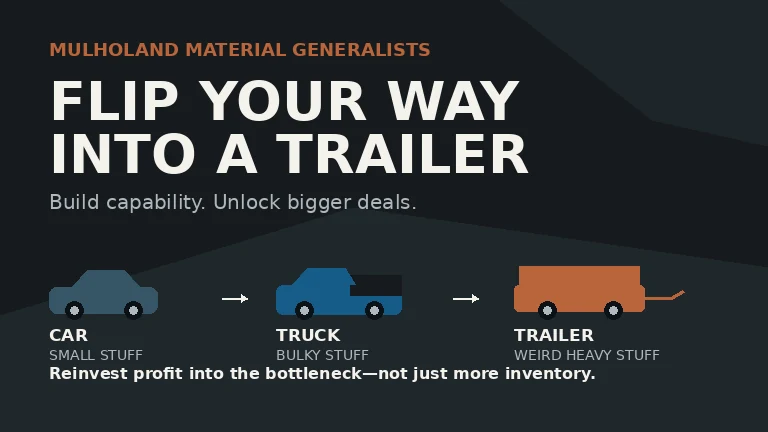
Your vehicle is part of your business model
Getting into flipping, scrapping, repair and general Marketplace degeneracy is fun because the first wins can happen fast. Buy something for $40. Clean it up. Sell it for $120. Spend twenty minutes answering a man named Tyler who asks “is this available?” and then vanishes into the mist.
Still. You made money.
Then the listings start changing. A riding mower for $100. A free commercial cabinet. A dead compressor. A washer-dryer set somebody needs gone tonight. An industrial lot that looks like it was priced by a person who has already mentally left the building.
And you realize a depressing fact:
If you cannot move it, it is not really your deal.
A car gives you one marketplace. A pickup gives you another. A trailer opens another layer again. Add ramps and a winch and suddenly “doesn't run” becomes less of a deal-breaker and more of a negotiating point.
That is why your vehicle, loading gear and storage are not side details. They are part of your personal infrastructure.
The uglier the object, the thinner the competition
The easiest products to understand attract the most buyers. A desirable cordless tool at half price is not exactly a secret. Everybody can recognize it, everybody can fit it in a car, and everybody can message the seller before you do.
Now make the item 700 pounds, non-running, covered in warehouse dust and available only between 2:00 and 4:00 on a Tuesday.
Excellent. Half the competition just disappeared.
Bulky equipment, appliances, mowers, engines, shop gear, scrap-heavy lots and business liquidations often carry a logistics discount. The seller may know the item has value. They may simply value getting it the hell out of their building even more.
That inconvenience is where margin can appear.
Not always, obviously. Sometimes the mysterious 900-pound object is worth $3,000. Sometimes it is a 900-pound method of discovering your local dump's fee schedule.
That is why the rule remains: know the exit before you buy. More hauling capacity gives you access to more opportunities. It does not make every giant rusty thing an opportunity.
Build a capability ladder, not a pile of random gear
The useful way to think about scaling is not “I need a truck.” It is: what capability is currently stopping me from taking profitable deals?
Tools, electronics, collectibles, parts, small appliances. Learn pricing and build cash without needing a private loading dock.
Appliances, mowers, scrap, engines, furniture and awkward Marketplace freebies become realistic.
Multiple units, bulk lots, larger equipment and things that absolutely were not fitting in the bed no matter how optimistic you felt.
Now the item does not even have to run. The seller's loading problem can become part of your discount.
You can hold slower-moving, higher-value inventory long enough to wait for the right buyer instead of panic-selling it Sunday night.
Notice that every step solves a specific problem. That matters because buying capability can become its own form of shopping addiction if you let it.
You do not need an enclosed trailer because enclosed trailers are cool. You need one if weather protection, security or cargo volume is repeatedly costing you real money.
Do not finance your way into fake growth
This is where the advice needs a giant asterisk.
If you currently make $300 a month flipping lawn tools, please do not interpret this article as permission to finance a brand-new heavy-duty truck, trailer and enough recovery gear to reopen the Oregon Trail.
The objective is not maximum towing capacity. It is maximum useful capability per dollar.
Before buying the next upgrade, I would want at least a few of these to be true:
- You have already missed multiple good deals specifically because of transport or loading.
- You can name the categories the upgrade will unlock—not just “bigger stuff.”
- You have a conservative estimate of the extra profit those deals can produce.
- You can afford the equipment without wrecking your emergency fund or putting side-hustle cosplay on a credit card at 29% APR.
- The equipment itself has a decent resale floor if the experiment does not work.
- You have somewhere secure and legal to keep it.
If you are not sure yet, rent or borrow the capability first. Rent a trailer for the deal. Borrow a pickup. Pay for delivery. Test whether bulky opportunities actually show up in your market before buying a permanent solution to a theoretical problem.
Three profitable bulky deals you could not otherwise do are evidence. Thirty saved Marketplace listings are a hobby.
Make the trailer prove it can pay for itself
Think about capability upgrades the same way you would any other business purchase: what incremental profit does this unlock?
Say you find a used utility trailer for $1,100. By the time you deal with a tire, wheel bearings, lights, registration and the hitch gear you actually needed, you are $1,500 into the setup.
You estimate that the trailer lets you take one extra bulky flip per month at an average of $175 net profit that you could not have made before.
The trailer may still retain substantial resale value, so its true economic cost can be lower than the cash you tied up. But the cash is still tied up. Tires still age. Bearings still need grease. Registration still exists because apparently society insists on paperwork even when we are trying to drag a pressure washer home.
I would use conservative numbers. If the purchase only makes sense when you assume four perfect flips every month forever, you have not made a forecast. You have made fan fiction.
The boring towing paragraph that keeps the trailer out of a ditch
Hauling capacity is useful only if the setup is actually rated for what you are doing.
Tow rating is not the only number. Vehicle payload, GVWR, rear axle rating, hitch rating, trailer GVWR, tires, brakes, cargo placement and tongue weight can all become the limiting factor. Manufacturer guidance commonly targets roughly 10–15% tongue weight for a conventional loaded trailer, but the correct setup is vehicle- and trailer-specific, so check the actual manuals and labels for what you own.
And remember: tongue weight lands on the tow vehicle. Filling a truck bed with tools, passengers and scrap while also hanging a loaded trailer on the hitch is how the simple “my truck can tow 10,000 pounds” conversation becomes more annoying.
Then secure the load properly. NHTSA says crashes involving objects in the road kill hundreds of people each year and specifically advises tying large objects directly to the vehicle or trailer and avoiding excessive cargo loads.
If you are buying a used trailer, also verify the VIN/certification information, ownership paperwork, lights, tires, coupler, safety chains, bearings, frame and brakes where applicable. The cheapest trailer in town becomes less exciting when you cannot title it or one wheel attempts independence at 55 mph.
Then storage becomes the next boss fight
Here is the beautiful part of solving a bottleneck: it creates a new bottleneck.
You bought the truck because you could not haul things. Then the trailer because the truck was not enough. Then the winch because apparently not everything on Facebook Marketplace has the courtesy to run.
Now you can bring home all kinds of weird profitable junk.
Where are you putting it?
Storage is powerful because it lets you exploit a time mismatch. The seller needs a bulky piece of equipment gone today. The correct buyer may not exist until next month. If you have the space and your capital is not dangerously tied up, you can wait.
A $1,500 motor that takes eight weeks to sell can still be a good asset if you have room. The same motor sitting beside your dining table becomes a different kind of economics discussion.
There is a line, though, between “inventory with a longer sales cycle” and “I have six broken pressure washers because technically each one has parts value.” We are going to come back to that line in another article.
Every flip should move you somewhere
This is the part that turns random side jobs into something that actually compounds.
The washer-dryer flip is not just $220. Maybe it buys the ramps.
The aluminum scrap run is not just $140. Maybe it buys the hitch.
The part-out project is not just cash. Maybe it funds the trailer.
The trailer unlocks a dead mower. The dead mower funds the winch. The winch lets you load an industrial machine that the seller practically gives away because everybody else asked, “how the hell would I move that?”
Now you have a feedback loop:
more capability → access to less convenient deals → less competition → more potential profit → more capability.
That is the actual idea behind flipping your way into a trailer.
Not “buy a truck because trucks are useful.”
Not “every heavy object is secretly worth thousands.”
And definitely not “go into debt buying toys and call them business infrastructure.”
Use early profits to remove the constraint that keeps making you say, “damn, I could make money on that if I could just get it home.”
Then solve the next constraint.
And the one after that.
Comments
Loading comments…