
My Charizard for Your Milwaukee M18 Impact Wrench
Trading Pokémon like currency sounds ridiculous right up until you compare a liquid collectible with a valuable part that has been occupying the same corner of your garage for four months.
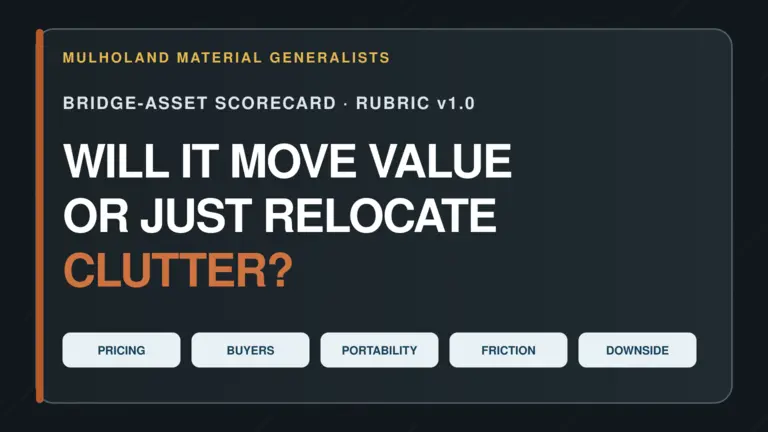
Will this move value—or just relocate clutter?
Judge the asset you would receive. Choose the description that best matches evidence you can verify today, not the appreciation story trying to rent space in your skull.
Methodology, bands and limitations
What is a bridge asset? It is something you accept temporarily because its observable market, buyer pool and practical exit may move value toward cash—or toward the next useful trade—more efficiently than the thing you already hold.
What the five factors mean. Pricing transparency asks whether completed sales—not fantasies with “firm” in all caps—support the value. Buyer depth asks how many real exits exist and how frequently they clear. Portability covers storage, transport and safe delivery. Selling friction covers fees, verification, negotiation and transaction labor. Downside risk covers condition, authenticity, volatility and the credibility of a fallback exit.
| Result band | Rule in rubric v1.0 | What it means |
|---|---|---|
| Strong bridge asset | At least four factors are strong and none are weak. | The exit looks practical, but current cash-equivalent value still controls. |
| Conditional bridge asset | Anything between the strong and trapped rules. | The asset may bridge a deal if the weak link is discounted or resolved. |
| Probably trapped value | Two or more factors are weak. | Too much of the exit depends on luck, patience, specialized labor or another buyer miracle. |
Weakest-factor rule. The result identifies the lowest judgment. If factors tie, it prioritizes buyer depth, selling friction, downside, pricing and portability—in that order—because a failed exit matters more than whether the object fits neatly on a shelf.
Limitations. This is a decision aid, not an appraisal or forecast. It does not predict appreciation, exact sale speed, fraud, taxes or a future buyer. Results are only as good as the item identification, condition check and completed-sale evidence used. Recheck the market when the deal changes.
Version and review: Rubric v1.0. Article evidence and links checked . See a defect or better source? Send a correction.
Worked example 1: sealed Evolving Skies booster box
- Pricing: strong
- Buyer depth: strong
- Portability: strong
- Selling friction: mixed
- Downside: mixed
PriceCharting showed a market price around $2,400 and roughly one tracked sale per day when checked Aug. 22, 2026. That supports pricing and buyer depth. Fees, shipping, reseal/counterfeit risk and price volatility keep the result conditional rather than magical.
Worked example 2: rebuilt 2004 Accord transmission
- Pricing: weak
- Buyer depth: weak
- Portability: weak
- Selling friction: weak
- Downside: mixed
This is an illustrative case, not a completed-sale dataset. Fitment, rebuild quality, freight and the need for one exact buyer make the headline value hard to convert. It might be useful to that buyer; it is a poor general-purpose bridge.
The hustle-economy problem: valuable doesn't mean liquid
We're living in a hustle economy. Side jobs become businesses. People part out junk cars, repair tools, haul scrap, flip equipment and scavenge the digital wasteland of Facebook Marketplace, Craigslist and OfferUp looking for something mispriced.
Then two boring constraints show up: cash and space.
Imagine you have a rebuilt transmission for a 2004 Honda Accord. Maybe it really is worth $750. Great. Now find the person who owns the right car, needs a transmission, trusts yours, lives close enough and has $750 ready to spend.
Until that person appears, your "$750 asset" is also a large metal object taking up floor space.
Now somebody offers $600 worth of desirable sealed Pokémon product instead. You don't collect Pokémon. That is not actually the important question.
The important question is: can you turn the Pokémon into useful value faster, cheaper and more reliably than you can turn the transmission into cash?
If yes, the collectible is not the destination. It's the bridge.
Why Pokémon can work unusually well as a bridge asset
Pokémon isn't literal currency. You can't pay the mortgage with an Elite Trainer Box. But in a private trade it can do one of money's jobs: move value from one person to another.
The reason it can work is not magic cardboard. It's market structure.
| Trait | Why it matters in barter |
|---|---|
| Big buyer pool | You are not waiting for the owner of one exact vehicle or machine. |
| Visible pricing | Recent completed sales give both sides a reference point. |
| Portable value | Hundreds or thousands of dollars can fit on a shelf. |
| Standardized products | A known sealed box is easier to compare than a home-rebuilt component. |
| Multiple exits | Collectors, card shops, marketplaces and other traders create options. |
PriceCharting is useful here because it builds market prices from completed sales data, including eBay and its own marketplace, using recency and other statistical inputs instead of simply treating somebody's ridiculous asking price as reality.
For a serious trade, I'd still cross-check PriceCharting, TCGplayer and recent eBay sold listings. If all three are telling roughly the same story and the item sells frequently, that's much stronger evidence than one screenshot saying "market value: $800."
The trade math that actually matters
Suppose your part is theoretically worth $750 and the Pokémon offered is worth $600. On paper, taking the Pokémon looks like lighting $150 on fire.
But now add reality.
| Niche car part | Liquid Pokémon product | |
|---|---|---|
| Headline value | $750 | $600 |
| Buyer pool | Narrow | Broad |
| Time to sell | Potentially weeks/months | Potentially days |
| Storage | Large | Tiny |
| Pricing evidence | Often sparse | Often abundant |
If the transmission eventually sells for $625 after four months of Marketplace nonsense, while the $600 Pokémon product can reliably net $540–$570 after selling friction this week, the real gap is no longer $150.
This is why I would assign two values to anything in barter:
Market value: what comparable items appear to trade for.
Cash-equivalent value: what you realistically expect to put in your pocket after fees, shipping, negotiation, fraud risk and time.
The second number should control the deal.
Why sealed Pokémon is especially interesting
Individual cards can be excellent trade assets, but condition and authenticity add friction. One person's "Near Mint" can look suspiciously like another person's "survived middle school in a backpack."
Sealed product can be easier to evaluate because you're dealing with a known product instead of grading dozens of cards. Counterfeits and reseals still exist, so authentication matters, but the market is more standardized.
And yes, sealed Pokémon can appreciate—sometimes absurdly.
TCGplayer recorded an Evolving Skies booster box at about $141 on its August 2021 release day, with an early low around $100. PriceCharting showed the box at roughly $2,400 when checked on Aug. 22, 2026, with about one tracked sale per day and recent completed sales generally in the $2,000-plus range.
That's spectacular. It is also not a promise.
Some sets soar. Some crawl. Some get reprinted. Demand changes. Anyone valuing every sealed box as "future Evolving Skies" is just gambling with nicer shelving.
The real advantage is liquidity plus possible appreciation. Appreciation is upside, not the reason to overpay today.
Why tools and collectibles age differently
The Milwaukee M18 FUEL 1/2-inch High Torque Impact Wrench in this article's premise is a genuinely desirable professional tool. Milwaukee's current 2967-20 is built for heavy mechanical and automotive work.
But useful tools generally depreciate as they're used: housings get beat up, batteries age, bearings wear and newer generations arrive.
A sealed collectible has the opposite incentive. Opening or damaging it destroys part of what collectors pay for. If demand survives while other copies get opened, remaining sealed supply can become more desirable.
That does not make Pokémon "better" than Milwaukee. It makes the two assets behave differently—which is exactly what can make a trade useful to both sides.
Five rules before I would take Pokémon instead of cash
- Know exactly what you're getting. Exact set, product, card and grade. No mystery "collection worth $1,200."
- Verify completed sales. PriceCharting is a starting point, not holy scripture. Cross-check actual recent transactions.
- Check sales volume. A $500 item selling every day is a different asset from a "$500 item" selling twice a year.
- Discount for friction and risk. Fees, shipping, condition, authenticity and volatility come out of your value.
- Know your exit before the trade. Sell immediately? Hold? Trade again? If the answer is "I'll figure it out," lower your valuation.
One boring catch: barter is still barter
Skipping cash does not magically skip taxes. The IRS says the fair market value of property or services received through barter can be taxable depending on the transaction, including business-related barter income. Keep records when the trade is part of a business or profit-making activity.
The bigger idea
This is not really an article about whether Pokémon is money.
It's about realizing that the path does not always have to be:
stuff → cash → different stuff.
Sometimes the better route is:
illiquid niche item → liquid collectible → cash or the next trade.
Your transmission doesn't necessarily need to find the one guy with the right Honda and $750 sitting in checking.
Maybe it just needs to find the guy with the right Honda and a sealed Pokémon box.
And somewhere else, somebody really might trade a Milwaukee impact wrench for your Charizard.
Different worlds. Same market.
Sources & verification
- PriceCharting methodology — completed-sales pricing
- PriceCharting — Evolving Skies booster box current market and completed sales
- TCGplayer — Evolving Skies release-day and early-market pricing
- Milwaukee Tool — M18 FUEL 2967-20 product information
- IRS Topic 420 — barter income
Editorial and rights note: This is an original MMG thought experiment. AI assisted with source checks, interface implementation and QA; published claims were reviewed against the cited sources. Pokémon and Milwaukee are referenced editorially and are not affiliated with MMG.
Comments
Loading comments…