
Sneaker Reselling Is Dying. Grown Men Are Now Waiting Outside Walmart for a Children's Toy.
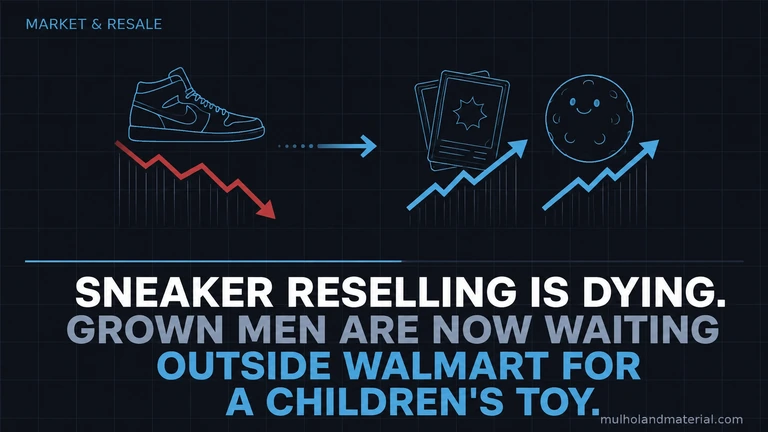
The sneaker flip economy collapsed. The people who ran it didn't quit — they found trading cards, Pokémon, and a $5 stress ball selling for $500 on eBay.
The sneaker resale economy had a good run. For about a decade, a certain type of person — almost always male, never embarrassed about it — could buy limited-edition Air Jordans at retail and flip them online for double or triple the price within the week. This was treated, with a straight face, as a business model. Some people made real money. Most people made enough to feel like they were beating the system, which was the actual product being sold.
That market is now structurally broken, and the people who made their side income there have moved on. Where they went is more interesting than where they left.
What Killed Sneakers
Nike killed it, mostly by accident. The brand spent years manufacturing scarcity on limited releases — the thing that made the resale premium possible — and then quietly reversed course. Too many "limited" drops. Too many colorways. Too many collaborations with people nobody had heard of. The scarcity was exposed as theater, and once collectors figured that out, they stopped paying theater prices.
The math stopped working at the platform level too. A standard Jordan Retro runs $215 after tax. StockX and GOAT take roughly 13% in fees. Shipping eats another $15. To break even on a resale, you need to sell for $265. Most general-release Jordans now sit on resale apps at $180 to $220. The average reseller is paying $40 for the experience of completing a transaction.
Pairs that were flipping for 100% to 200% premiums as recently as 2023 now move near or below retail. A Lost & Found Jordan 1 — coveted enough in 2023 to fetch $500 — goes for around $280 today, if it goes at all. The Wall Street Journal ran numbers on this. NPR did a segment. Even sneaker media, which has a structural interest in hype, has started calling it a collapse.
The era is over. The question is what replaced it.
Trading Cards: The Infrastructure Was Already There
Here is what sneaker reselling and trading card reselling have in common: authentication platforms, condition grading, secondary marketplaces, buyers comfortable paying a premium for scarcity, and a customer base that has convinced itself it is investing rather than collecting. The behavioral DNA is identical. The product is different.
Trading card revenue in the United States hit $6.2 billion in 2026, a 13.5% increase over the prior year. eBay logged ten consecutive quarters of rising card sales. Walmart reported trading card sales up 200% on its marketplace over a recent 16-month period. Target is tracking toward more than $1 billion in trading card sales in a single year — up nearly 70% — driven primarily by one franchise.
That franchise is Pokémon, which is thirty years old this year and currently behaving like it just discovered stimulants.
Three things happened simultaneously in 2026 that a supply-constrained collectibles market was not equipped to handle: Pokémon's 30th anniversary, the 75th anniversary of Topps baseball cards, and the FIFA World Cup landing in North America and supercharging demand for soccer cards in a market that had never much cared about soccer cards. Three independent demand spikes, same calendar year, same set of platforms, same pool of resellers looking for somewhere to go after sneakers stopped making sense.
A PSA 10 Pikachu Illustrator card sold for $16.49 million in February 2026. That is the most expensive trading card of any kind ever sold. The card in question depicts a cartoon electric mouse.
Sealed vintage Base Set booster boxes — the original 1999 packs, unopened — topped $400,000 at auction heading into the anniversary. For context, the cardboard inside weighs roughly as much as a granola bar.
The buyer demographics are not who you might expect. Roughly one in five American adults reported buying Pokémon cards for themselves in the prior six months, according to a Circana survey. Only about a quarter of those buyers play the game. The rest collect, display, or resell. StockX — the sneaker authentication platform that had to pivot into adjacent categories after its core market softened — reported Pokémon resale up 367% year over year on its platform. The resale consumer did not leave. They updated their inventory.
The Squishy Toy Situation
Separate but related: there is currently a $5 stress ball that people are paying $500 for on eBay, and this is being treated as normal.
NeeDoh is a line of sensory fidget toys made by Schylling, a Massachusetts toy company. The product is a stretchy, squishy, blob-shaped object that can be squeezed, pulled, and generally manipulated in ways that produce no particular outcome. It comes in shapes including a gumdrop, a gummy bear, and a cube. It retails for between $5 and $10. It went viral on TikTok sometime in late 2025, and within the first nine weeks of 2026, Schylling had sold through its entire year's worth of inventory.
"No company can plan for that," Schylling's CEO told Business Insider.
The shelves went bare. eBay searches for NeeDoh jumped more than 700% in a single month. StockX, which had recently begun tracking NeeDoh prices alongside its sneaker and card inventory, showed the toys selling for four to five times retail during the peak. A NeeDoh Nice Cube — the cube — listed for $500. A mixed bundle hit $799 in tracked resale data. The highest resale price recorded for a single NeeDoh Smiley Face variant reached $699.
There are now videos on TikTok and Instagram of people lining up outside stores before opening, waiting for a NeeDoh restock, in the same posture that people once used to wait for Air Jordans. The behavior is structurally identical. The object being waited for costs less than a fast food combo meal.
Resellers, recognizing the pattern, deployed the same bots previously used to clear out sneaker inventory. Some retailers, having experienced this dynamic before, refused to stock NeeDoh at all until the craze cooled. Counterfeits appeared within weeks of the price spike, following the standard playbook: viral product, empty shelves, inflated secondary market, fake versions flooding in from overseas. Schylling issued public warnings. The infrastructure of hype, once built for $200 shoes, was now fully operational for $8 stress balls.
The Actual Pattern
Sneakers were never really about sneakers. They were a vehicle for a set of behaviors — the hunt, the score, the flip, the flex — that are portable across product categories as long as the underlying conditions are met: artificial or genuine scarcity, a viral ignition event, authentication infrastructure to establish grades and prices, and platforms liquid enough to support a secondary market.
Those conditions can attach to almost anything. They have attached, at various points, to Funko Pops, Lego sets, hot sauce, and limited-edition Stanley cups. The attachment is temporary. The people doing the attaching are not.
What is different now is the infrastructure. A decade of sneaker culture built authentication standards, grading services, and liquid marketplaces that work across categories. StockX, eBay, Mercari, and Facebook Marketplace have become general-purpose scarcity-arbitrage platforms. Trading cards have PSA. NeeDoh has eBay sold comps and resale trackers publishing price guides updated daily. The machinery that made sneaker reselling feel like a business now runs on whatever the algorithm decided was interesting this month.
The sneaker resellers did not quit. They enrolled in a continuing education program with no fixed curriculum. This month's assignment happens to be a squishy toy shaped like a cube.
Sources & verification
- NPR — The resale market for sneakers is tanking (Jan. 2026)
- BallerStatus — Sneaker market crash data analysis, Q2 2026
- Axios — Pokémon, trading cards have leveled up to retail gold
- VTM Vending — Pokémon trading card market USA: 2026 data
- Modern Retail — NeeDohs are fetching a premium on resale sites
- AOL / Business Insider — NeeDoh viral demand; CEO quote on inventory
- Sell Your Toys Now — NeeDoh value guide and market analysis (2026)
- Measure Protocol — Sneaker resale market signals 2026; StockX category diversification
Article evidence and links checked Aug. 23, 2026. Editorial process →
Comments
Loading comments…