
Iran Is Doing the Hawks' Recruiting Work for Them
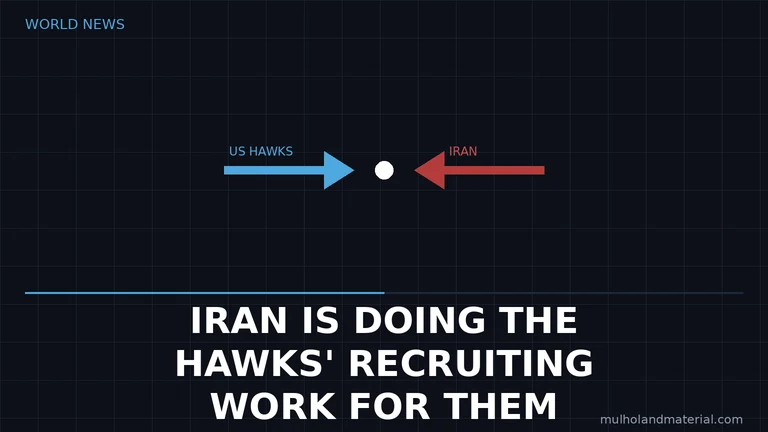
A $30,000 bounty on American soldiers, announced to state media, with no US ground troops in Iran to collect it from. The US created the conditions for this. Iran is making the most of them.
On August 16, Iranian Army Chief Maj. Gen. Amir Hatami announced that any Iranian citizen who kills or captures a US service member will receive 5 billion tomans — roughly $30,000. Women who do so get $60,000. He said the plan was drawn up after the military received "numerous requests" from Iranians eager to participate in the war effort. The announcement was carried by state broadcaster IRIB and distributed by the IRNA state news agency.
There are no known US ground forces inside Iran. The only acknowledged deployment of American troops on Iranian soil was a rescue operation in April — roughly 200 personnel and more than 170 aircraft sent to extract the weapon systems officer of a downed F-15. They got him out. Iran is now offering $30,000 for soldiers it doesn't currently have access to, through a mechanism — civilian bounty hunting — that has no plausible operational path against a US military force.
This tells you something, but probably not what the headlines suggested.
What the US did to get here
This conflict did not begin in February. It began, depending on how far back you want to go, in 1953, when the CIA and British intelligence overthrew Iran's democratically elected prime minister Mohammad Mosaddegh to protect Western oil interests. That operation installed the Shah, whose rule lasted until the 1979 revolution that created the government the US has been in conflict with ever since.
The more recent ledger: the US withdrew from the JCPOA nuclear deal in 2018 under Trump's first term, reimposing sanctions that sent Iran's currency into freefall. In June 2025, the 12-Day War — Israeli strikes on Iranian nuclear and military facilities, followed by US entry into the conflict nine days in — killed at least 610 Iranians including 436 civilians, and ended in a ceasefire brokered by the US and Qatar. That ceasefire held until February 28, 2026, when the US and Israel launched coordinated strikes that killed Supreme Leader Khamenei in the opening hours. In January 2026, Iranian security forces killed at least 30,000 protesters during a crackdown on demonstrations that the US had explicitly encouraged.
The US then launched what Britannica describes as its largest military buildup in the Middle East since the 2003 Iraq invasion. A 40-day war followed, then an April ceasefire, then a June framework for peace talks that collapsed. Fighting has continued sporadically since, centered on southern Iran and the Strait of Hormuz. Seventeen US military personnel have been killed since the conflict began.
None of this is a defense of the Iranian government, which is authoritarian and has spent decades funding regional proxy forces, threatening Israel, and suppressing its own population with extraordinary violence. It is context that the bounty coverage largely omitted.
What the bounty actually is
The bounty is not a serious military operation. It is a propaganda product optimized for domestic consumption — a way for a government under sustained military and economic pressure to project defiance and solicit emotional investment from its population. The same announcement included a claim that Iran had devised a plan offering rewards for killing or capturing US troops in the event of a ground incursion. That conditional framing tells you what this is: preparation theater for a scenario that hasn't happened.
The Defence Security Asia analysis described the bounty's real value as psychological: projecting popular resolve, threatening distributed resistance, and challenging Washington's assertion that American forces dominate the contested maritime space. That is an accurate read. Iran is telling its citizens it has a plan. The plan doesn't require operational viability to serve its actual function.
The offensive doctrine announcement works the same way. Iran's Army Spokesman Brig. Gen. Akraminia told IRNA that the country's doctrine had "shifted from defensive to offensive," citing lessons from the 12-day and 40-day wars. He stressed that offensive doctrine doesn't necessarily mean preemptive operations — an immediate walk-back that reveals the announcement's purpose. Iran is not describing a new military strategy. It is issuing a statement of intent for an audience at home.
Why this is self-defeating
Here is the problem for Iran: these announcements are not evaluated only by Iranian audiences.
Every time Iran announces a bounty on American soldiers, every time it declares an offensive military posture, it generates American news coverage that makes continued US involvement easier to justify politically. The argument for escalation — that Iran is a direct, stated threat to American lives — gets handed a fresh data point. The Americans who wanted this war from the beginning, who saw the 12-Day War ceasefire as a mistake and pushed for the February strikes, read each of these announcements as confirmation.
Iran is not wrong that the US started it. The historical record on American intervention in Iran is long and unflattering, from Operation Ajax in 1953 to JCPOA withdrawal in 2018 to the killing of Khamenei in March 2026. A country that has been the target of a foreign-backed coup, 40 years of sanctions, the assassination of its supreme leader, and the bombing of its nuclear facilities has legitimate grievances.
But legitimate grievances and effective strategy are different things. Announcing a civilian bounty on foreign soldiers, in state media, with no mechanism to collect it, gives those soldiers' government a gift. It costs Iran nothing in actual military capability. It costs Iran something real in the international framing of the conflict, and hands American hawks a headline they didn't have to earn.
The country acting as if it wants Americans to support this war is Iran. The country that created the conditions Iran is operating in is also America. Both of those things are true at the same time, and neither cancels the other.
What to actually watch
The Strait of Hormuz is the actual story. Roughly 20% of global oil passes through a waterway that Iran has repeatedly threatened to close and that the US Navy is deployed to keep open. The Islamabad Memorandum of Understanding, signed June 17, set a 60-day framework for negotiations that has since reportedly collapsed. Sporadic fighting continues in southern Iran. Iran's defense ministry has claimed domestic weapons production doubled in the past year despite strikes on defense facilities.
The bounty won't determine what happens next. The Strait will.
Verdict
The US went into this conflict after decades of intervention that gave Iran's government every incentive to harden and arm. That history is real and the consequences are now visible in every exchange of fire over the Strait of Hormuz.
Iran's response to that history — announcing civilian bounties, declaring offensive doctrine to state TV, issuing proclamations calibrated for domestic morale rather than military effect — is not a strategy. It is a performance that makes the people most responsible for starting this conflict look reasonable by comparison, which is a significant achievement given the circumstances.
Seventeen Americans have died. More than 1,300 Iranian civilians have been killed since February. The peace talks collapsed. The Hormuz corridor is contested. None of that changes because Hatami announced a $30,000 bounty to state media. What changes is the political environment in Washington. And Iran keeps changing it in the wrong direction.
What would change this
If US forces conduct a significant ground operation inside Iran, the bounty framework becomes operationally relevant and this analysis changes. If Iran's offensive doctrine shift produces documented preemptive strikes that go beyond what it has done to date, the framing of "propaganda product" requires revision. Conversely, if the Islamabad framework is revived and produces a durable ceasefire, the bounty and doctrine announcements become historical footnotes from the low point of the conflict. Watch the Strait, not the press releases.
Sources & verification
- Stars and Stripes: bounty amount, Hatami statement, 17 US deaths since conflict began
- France 24: April F-15 rescue operation, ceasefire and peace talk collapse timeline
- The Defense Post: 1,300+ Iranian civilian deaths since February, no known US ground forces inside Iran
- Defence Security Asia: psychological value of bounty, Hormuz strategic context
- Britannica (2026 Iran war): February 28 strikes, Khamenei killed, 30,000 protesters killed, largest US military buildup since 2003
- Al Jazeera: 12-Day War timeline, 610 Iranian deaths including 436 civilians
- Britannica (US-Iran timeline): 1953 coup, JCPOA withdrawal 2018
- Cumhuriyet Daily / Anadolu: Akraminia doctrine statement, offensive posture walk-back
Article evidence and links checked Aug. 23, 2026. Editorial process →
Comments
Loading comments…