
Canada Is Playing Chess With Wisconsin
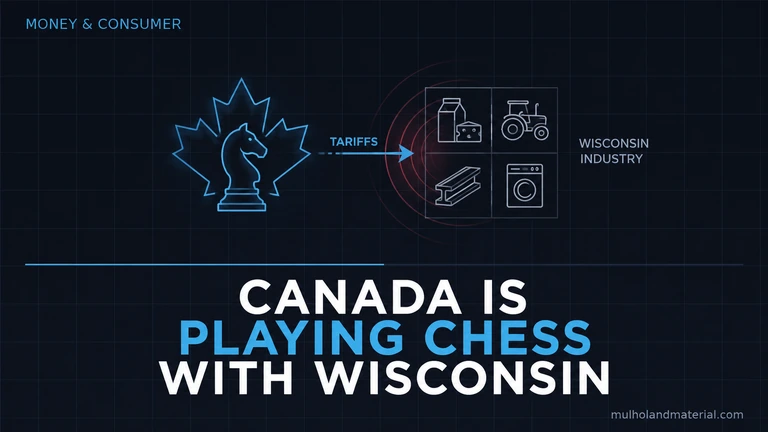
Steel · Dairy · Farm equipment · Appliances · Pulp & paper · Electronics
Ottawa's retaliation targets look less like a shopping list and more like a map of industries capable of making politically important phone calls.
At 12:01 a.m. Saturday, a new set of U.S. tariffs on certain Canadian goods took effect at 50%. The measures cover a relatively narrow slice of Canadian exports, but the list includes politically legible products such as alcohol, dairy, vehicles and other manufactured goods. After trade talks collapsed, Prime Minister Mark Carney announced that Canada would answer dollar for dollar beginning September 8.
The sectors Canada named are steel, dairy, appliances, agricultural equipment, pulp and paper, and electronics. Ottawa has not yet published the detailed tariff lines or rates.
So yes, this is retaliation. But history suggests there is a second question worth asking: retaliation against what, exactly—the trade measure, or the politicians with the most reason to make it stop?
The old playbook
Canada has done this before. During the 2018 tariff fight, Maryscott Greenwood of the Canadian American Business Council described the logic to CBC in unusually plain terms: map influential members of Congress to the major industries in their districts, then design the retaliation list accordingly. The 2018 list included politically recognizable products such as Kentucky bourbon, Florida orange juice and Pennsylvania chocolate.
The point was not necessarily to maximize economic destruction per tariff line. It was to maximize complaints from businesses with somebody useful to call. A tariff on a globally tiny product category can still be effective if the factory, farm or trade group behind it has the right senator on speed dial.
Canada used politically legible goods again during the 2025 dispute, then removed most counter-tariffs on CUSMA-compliant U.S. products that September while retaining some measures on steel, aluminum and autos. The 2026 package is being built fresh rather than simply switching the old list back on.
What the 2026 sectors tell us
The detailed schedule is still missing, so this is where analysis has to stay on a leash. But the sectors already point toward several U.S. regions where Canada matters a lot.
Dairy: Wisconsin is the obvious example. Canada was Wisconsin's largest overall export market in 2025, buying $7.5 billion in goods—28% of the state's total goods exports. Separately, Wisconsin's dairy economy supports about 120,700 jobs and $52.8 billion in annual industrial revenue. A Canadian dairy tariff therefore lands in a state where both the industry and the Canadian market are hard to ignore.
Agricultural equipment: this one is even more geographically concentrated. University of Illinois farmdoc analysis using BLS data found that one quarter of U.S. jobs in agricultural, construction and mining machinery manufacturing are located in just Iowa, Illinois and Wisconsin. Iowa had 21,780 jobs in the industry in 2025, the highest of the Midwestern states examined. Canada also bought about $4.9 billion of Iowa goods in 2025, roughly 30% of the state's exports.
Steel, appliances, paper and electronics: these broaden the pressure beyond farms. Steel points toward the Great Lakes and Ohio Valley; appliance manufacturing has significant Midwestern and Southern footprints; pulp and paper reaches into the Great Lakes, Northeast and Pacific Northwest. The exact factories and congressional districts will depend on the tariff codes Ottawa publishes.
That last sentence matters. “Dairy” is not a tariff line. Neither is “electronics.” The sector announcement tells us the direction of travel, not which company gets the invoice.
Who actually pays
The immediate U.S. tariffs are collected from U.S. importers bringing covered Canadian goods into the country. Businesses then decide how much of that cost to absorb and how much to pass through in higher prices. That means the American side of the dispute can reach consumers through imported food, beverages and manufactured goods.
Canada's retaliation works in the opposite direction. Canadian importers pay the Canadian tariffs, while U.S. exporters face a worse price position in one of their biggest foreign markets. Canada was the top goods export market for 27 U.S. states in 2025.
The scale of the relationship is large enough that even a targeted fight has spillovers. U.S.-Canada goods and services trade totaled about $872 billion in 2025. Nobody needs to tariff all of it to make a mess.
Farm equipment is a good example. The machinery market was already dealing with weaker farm income, tighter credit and slower replacement cycles before this round escalated. A tariff does not magically move a Wisconsin or Iowa factory to Canada. It just makes the Canadian-bound machine harder to sell profitably while Canadian farmers stare at a higher delivered price. Very efficient system. Everyone gets annoyed.
The large Canadian asterisk
The strongest objection to the political-targeting read is simple: the actual 2026 list does not exist yet. Carney named sectors, but Canada has not published the HS codes or rates. A broad list designed mainly to protect Canadian producers could look very different from a surgical list designed to make particular U.S. lawmakers hear about it.
There is also an ordinary economic explanation for several sectors. Steel mirrors existing U.S. metals pressure. Dairy was directly involved in the failed negotiations. Appliances, paper and electronics are large traded categories with Canadian producers of their own. Political pressure and domestic protection are not mutually exclusive; governments are perfectly capable of doing two things with one tariff. Bureaucracy occasionally discovers efficiency by accident.
And Ottawa has an incentive not to overdo the surgery. Carney explicitly acknowledged that retaliation will raise costs and reduce choice for Canadians, and that some U.S. companies and states are bystanders. A politically elegant tariff is less elegant when voters at home are paying for it.
Verdict
The political-targeting theory survives, but only as a strong hypothesis for now. Canada's history says it understands exactly how to choose retaliatory products for political leverage. The announced 2026 sectors overlap industries concentrated in states with substantial dependence on Canadian demand. Wisconsin dairy and Iowa farm equipment are particularly obvious places to watch.
But the detailed tariff schedule is the evidence that matters. If Ottawa selects narrowly defined products concentrated in politically sensitive districts, the theory gets much stronger. If the list is broad and mostly mirrors Canadian industrial interests, it gets weaker.
Either way, September 8 is not just a trade date. It is the day we find out whether Canada brought a spreadsheet to this fight or a congressional map.
What would change this
Three things would materially change the read: a broad product list with little geographic concentration; a resumption of negotiations that prevents the tariffs from taking effect; or tariff codes aimed mostly at sectors where Canadian import substitution is easy rather than where U.S. political pressure is useful.
There is another clock running behind this one. At the mandatory July 1, 2026 USMCA review, the United States declined to extend the agreement in its current form while Canada and Mexico supported an extension. The pact continues, but annual reviews now add a recurring negotiation point. That makes every tariff fight between now and the next review part trade dispute, part positioning exercise.
Sources & verification
- Prime Minister of Canada — Aug. 22 remarks announcing dollar-for-dollar retaliation and the six sectors
- White House — temporary suspension setting the new U.S. tariff effective date at Aug. 22, 2026
- Reuters — trade-talk collapse, approximate value of affected Canadian exports and Sept. 8 retaliation
- U.S. Trade Representative — Wisconsin exports and Canada market share, 2025
- U.S. Trade Representative — Iowa exports and Canada market share, 2025
- U.S. Trade Representative — U.S.-Canada trade totals, 2025
- University of Illinois farmdoc daily — Midwest machinery employment and exports, Aug. 6, 2026
- Radio Canada International / CBC — Canada's 2018 political-targeting tariff strategy
- Progressive Policy Institute using U.S. Commerce data — Canada as top export market for 27 states, 2025
- University of Wisconsin Extension — Wisconsin dairy economic contribution and employment
Verification note: evidence and links checked Aug. 23, 2026. Canada's exact Sept. 8 tariff lines and rates had not yet been published when this article was prepared. Editorial process →
Comments
Loading comments…