
Ozempic Is Working. That Might Be Part of the Problem.
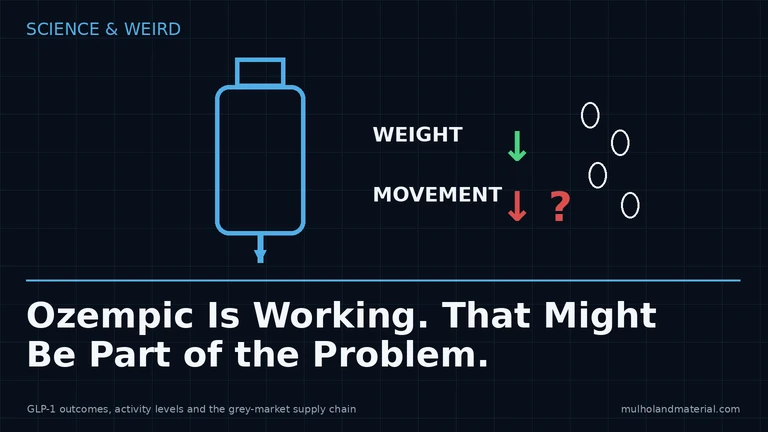
People on GLP-1 drugs are losing weight and moving less. They're also buying the stuff from med spas, telehealth apps, and overseas dealers. Here's what the research actually shows — and what the supply chain doesn't want you thinking about.
The story everyone knows about Ozempic is the weight loss story. Person starts semaglutide. Person stops thinking about food constantly. Person loses 15 to 20 percent of their body weight over a year. Person looks great at Thanksgiving.
That story is largely true. The drugs work. The clinical data is solid enough that the WHO commissioned three major reviews, and all three reached the same conclusion: GLP-1 receptor agonists produce meaningful, sustained weight loss at a scale that diet alone doesn't reliably achieve. For people with serious obesity and its downstream consequences — heart disease, sleep apnea, type 2 diabetes — the benefit is real and significant.
What the story leaves out is also real, also significant, and getting clearer by the month.
You're Lighter. You're Also Moving Less.
Research presented at ENDO 2026, the Endocrine Society's annual meeting, tracked Fitbit data from people with obesity before and after starting GLP-1 medications. The finding contradicted what most people — including most doctors — assumed would happen.
After starting Ozempic, Wegovy, Mounjaro, or Zepbound, participants moved less. Average daily steps fell from 5,047 to 4,487. Time spent in moderate-to-vigorous physical activity dropped from 28 minutes to 22 minutes per day. The declines were consistent regardless of age, prior heart failure, or history of stroke. The largest drops appeared in men and in people with pre-existing joint or muscle pain.
The intuitive assumption is that a lighter body moves more easily, so weight loss should produce more movement. The data says otherwise. The lead researcher described the finding as a surprise. It shouldn't entirely be — the drugs suppress appetite at the neurological level, and fatigue is among the more common side effects. A person eating less, absorbing fewer calories, and managing nausea is not necessarily a person with more energy to spare.
This matters because of what GLP-1 drugs do to muscle. They reduce lean mass alongside fat. That is not unique to these drugs — any meaningful weight loss involves some muscle loss — but the concern is the ratio and the trajectory. You're losing some muscle pharmacologically while simultaneously doing less to counteract it. The long-term result of that combination, sustained over years, is not fully understood because the drugs haven't been around long enough to study it at that timescale. That honest uncertainty is worth sitting with.
The Supply Chain Nobody Wants to Talk About
The clinical story — drugs working, exercise declining, muscle questions unresolved — is happening alongside a parallel story about where a large number of people are actually getting these drugs, which is not from a doctor's office.
During the shortage years of 2022 through 2024, the FDA permitted compounding pharmacies to produce semaglutide because Wegovy and Ozempic were genuinely unavailable. Compounding is a legitimate practice: pharmacies can legally produce custom formulations for patients who can't use standard commercial products. This created a legal, accessible, significantly cheaper alternative during a period when the brand-name drugs were backordered by months.
The shortage ended. The compounding didn't.
A secret-shopper study published in JAMA Health Forum in July 2026 by a University of Colorado team contacted weight-loss clinics and med spas across Oklahoma and West Virginia. They found 75 businesses still selling compounded semaglutide or tirzepatide after the shortages ended — which is now legally prohibited unless there's a documented clinical reason the brand-name drug won't work for that specific patient. Of the 23 compounding pharmacies supplying those businesses, four did not hold the license required for sterile compounding. Several had recent disciplinary actions or FDA warning letters already on file.
Sterile compounding is not a technicality. Injectable medications mixed in non-sterile conditions can carry bacterial contamination, incorrect dosing, or unlisted additives. The FDA logged 605 adverse event reports tied to compounded semaglutide through mid-2025. The actual number is probably higher, because adverse event reporting for compounded drugs is voluntary and inconsistent.
The overseas market is harder to quantify and worse. Online sellers and telehealth platforms operating outside US jurisdiction market products using language like "same active ingredient as Ozempic" or "from the same family as Wegovy." The FDA's 2026 warning letters have specifically targeted those phrases as false and misleading — the salt forms used in some compounded products differ from the base form in brand-name drugs, and that difference matters pharmacologically. Australia's TGA issued warnings about counterfeit Ozempic pens imported from overseas and confirmed as health risks. The products look like the real thing. They aren't.
The grey market exists for a clear reason: brand-name GLP-1 drugs are expensive. Wegovy lists at roughly $1,350 per month before insurance. Many insurance plans don't cover it for weight loss, only for diabetes. Compounded versions during the shortage ran $200 to $400 per month. The price differential is not a small inconvenience. It is the difference between access and no access for a large portion of the people who would benefit from these drugs. The grey market is, in part, a rational response to a broken pricing system.
That doesn't make the unlicensed version safe. It makes the situation genuinely complicated, which is different from having a simple villain.
What the Honest Version of This Looks Like
GLP-1 drugs are the most effective pharmacological weight loss tools ever developed. The cardiovascular and metabolic benefits for high-risk patients are documented and significant — a large 2026 study found women on these drugs were about 30% less likely to develop breast cancer, a finding that surprised researchers and is still being investigated.
They also suppress movement in people who are already sedentary, reduce muscle mass alongside fat, carry real risks when sourced from unregulated suppliers, and are being taken by millions of people without the kind of long-term safety data that a drug taken indefinitely actually requires. The researchers are not hiding this. Most of the clinical literature on these drugs includes honest acknowledgment of what isn't known yet.
The popular coverage largely doesn't. It covers the weight loss numbers, the celebrity before-and-afters, the shortage drama, and the price complaints. It doesn't spend much time on a 22-minute average exercise session, or on what happens to a 55-year-old's muscle mass over five years of GLP-1 use combined with declining physical activity, or on what exactly is in the $250 monthly injection from a telehealth app that didn't list its compounding pharmacy anywhere on the website.
Those questions have answers in progress. The honest answer to most of them right now is: we don't fully know yet. That's not a reason to avoid the drugs. It is a reason to be skeptical of anyone — a manufacturer, a clinic, a social media account — who presents this as a story with no complications.
Sources & verification
- Endocrine Society — ENDO 2026: Exercise decreases among GLP-1 users (June 2026)
- SciTechDaily — Researchers expected Ozempic weight loss to boost exercise. It didn't. (June 2026)
- University of Colorado Anschutz — lead researcher statement on JAMA Health Forum secret-shopper study; 75 businesses, unlicensed compounders (July 17, 2026)
- Healio/Endocrinology — JAMA Health Forum study detail; DiStefano quote; 23 compounding pharmacies, 4 without sterile license (July 17, 2026)
- ScienceDaily — WHO-commissioned Cochrane reviews on GLP-1 efficacy (Feb. 2026)
- Australia TGA — Counterfeit Ozempic pen warnings
- ScienceDaily — GLP-1 drugs linked to 30% lower breast cancer risk (June 2026)
Article evidence and links checked Aug. 24, 2026. Sources updated to primary and institutional references. Editorial process → This article is informational and does not constitute medical advice.
Comments
Loading comments…