
Elon's Biggest Fear Is Population Collapse. He's Also Building Its Replacement.
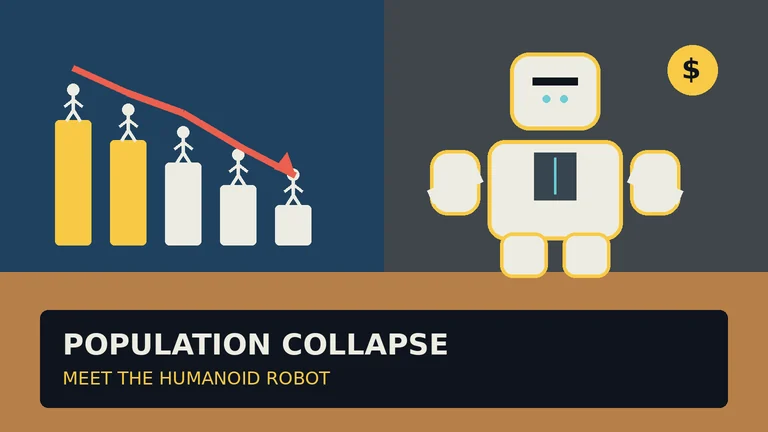
Musk has spent years warning that a shrinking population could wreck civilization. Tesla is building the machine that would make economic output less dependent on human headcount.
Over the weekend, Elon Musk replied to an X post claiming 2026 may be the first year humanity as a whole falls below replacement fertility. His response was seven words: “I've been warning about this for years.”
He has. Musk has been calling population decline a major civilizational threat for years. But the viral 2026 claim runs ahead of the best global baseline we have: UN DESA put global fertility at about 2.2 births per woman in 2024 and projects the world average to reach the roughly 2.1 replacement level around 2050, not 2026.
The demographic problem is real. The calendar attached to the viral post is shakier.
What Musk rarely puts next to the warning is that his own company has spent years building one of the most direct technological answers to labor scarcity: a humanoid robot designed to do physical work humans currently do.
The robot in the room
Optimus is Tesla's bet that a general-purpose machine can eventually handle factory, warehouse and other physical tasks. Musk told Tesla employees in 2025 that the company aimed to build about 5,000 Optimus units that year. It did not hit that target.
Chinese manufacturers did move into the thousands. AgiBot shipped just over 5,100 humanoids in 2025, while Unitree later said its own deliveries exceeded 5,500. By the first half of 2026, Reuters reported Chinese manufacturers had delivered more than 40,000 humanoids — about 97% of global deliveries.
Musk is not pretending that competition does not exist. On Tesla's January earnings call, he said China's robotics companies would be Tesla's toughest competition and that, to Tesla's knowledge, there were no comparably significant humanoid rivals outside China.
Here is the tension: if humanoid robotics eventually works as advertised, then one of its biggest economic effects is to weaken the link between how many working-age humans you have and how much physical work your economy can produce.
That does not make population decline harmless. Robots do not raise children, form families, vote, consume like households or magically solve elder care. But they could make a shrinking labor force less economically catastrophic than the old demographic models assume. Musk is warning about the labor shortage while trying to build the labor substitute.
The real problem is not just headcount
The fertility trend itself is stark. The UN says about 55% of countries and areas — containing more than two-thirds of the world's population — were already below replacement fertility in 2024. South Korea's rate rose in 2025 but was still only about 0.80. In the United States, the Congressional Budget Office estimates fertility around 1.6 births per woman.
So yes: the age structure is changing. Fewer workers will be supporting more retirees in many rich countries. But “fewer workers” and “civilization collapses” are not the same claim.
Social Security shows why. The program is funded primarily through payroll taxes on covered earnings. In 1950 there were 16.5 covered workers for every OASDI beneficiary. By 2025 the ratio was about 2.6 to 1, and the 2026 Trustees project roughly 2.3 workers per beneficiary by 2040.
That is a real financing problem. Congress has not enacted a long-term fix, and the usual choices are politically delightful in the way dental surgery is delightful: collect more revenue, slow benefits, raise retirement ages, or mix several unpleasant things together.
A British think tank recently modeled what it would take to preserve today's worker-to-pensioner ratio in the United Kingdom. Its answer: the state pension age could eventually have to reach 75 for children who are eight or younger today. That is a model, not a government forecast, but it demonstrates the arithmetic.
Then the robots show up
Now add automation to a retirement system funded mainly by human earnings.
If a company replaces part of a human workforce with machines, the company still pays taxes on profits and people still pay taxes elsewhere in the economy. But the machine itself does not generate a payroll-tax contribution the way the displaced worker did. At large scale, that distinction matters.
The idea of taxing automation is not new. Bill Gates famously floated a “robot tax” in 2017, and economists and policymakers have kicked around variations ever since. The United States has not adopted anything resembling a broad mechanism that automatically redirects the value created by robot labor into Social Security or similar systems.
That is the more interesting demographic problem: not merely whether there will be enough humans to perform every job, but whether institutions designed around taxing human labor can adapt if human labor stops being the dominant input.
The one thing robots cannot do yet
There is also a limit to the “just build robots” answer.
People are not only units of labor. They are consumers, caregivers, entrepreneurs, researchers and the source of the ideas that built Optimus in the first place. Today's humanoids still depend on huge amounts of human engineering, teleoperation, training data and maintenance. They are nowhere near an economy in which machines autonomously invent, build and improve the next generation of machines.
If that changes, we have wandered into a different article and probably a significantly weirder tax debate.
So Musk is not wrong that low fertility creates serious long-term problems. He is incomplete about what those problems become in a world with increasingly capable automation.
A smaller workforce can strain pensions, health systems and caregiving. But if robots increasingly do the work, the central question shifts from “where will we find enough workers?” to “who owns the machines, who receives the income, and how does society tax the output?”
Population decline may still be a crisis. Optimus just makes it a much stranger one.
Sources & verification
- Times of India — Musk's Aug. 2026 response to the viral replacement-fertility claim
- Fox Business — Musk warning in July 2021 that population collapse could be a major risk to civilization
- United Nations DESA — World Fertility 2024; global TFR about 2.2, 55% of countries/areas below replacement, projection to 2.1 around 2050
- Congressional Budget Office — The Demographic Outlook: 2026 to 2056; U.S. fertility estimates and projections
- Reuters — South Korea's total fertility rate rose to 0.80 in 2025
- Reuters/Investing — Musk's 5,000-unit Optimus production target for 2025
- Associated Press — Unitree and AgiBot each shipped more than 5,000 humanoids in 2025
- Reuters — China delivered 40,000+ humanoids in H1 2026, about 97% of global deliveries
- Tesla Q4 2025 earnings-call transcript — Musk on China as Tesla's toughest humanoid-robot competition
- Social Security Administration — 2026 Trustees Report, covered workers per beneficiary
- Centre for Social Justice — Baby Bust; modeling of a state pension age reaching 75 to maintain the current UK dependency ratio
- Axios — Bill Gates' 2017 proposal to tax robots or the companies deploying them
Article evidence and links checked Aug. 24, 2026. The viral claim that 2026 is already the first year of global sub-replacement fertility is presented as a claim, not as established demographic fact; the UN's current baseline remains above replacement. Editorial process →
Comments
Loading comments…